We earn a commission if you buy through our links, at no extra cost to you.
Best Aquarium for Beginners: Three 20-Gallon Kits
Why a 20-gallon kit is a forgiving first tank, what the nitrogen cycle means, and how three starter kits differ on heater, filter, size and weight.
At a glance
A 20-gallon kit with a heater is the most forgiving first tank. The Aqueon 20 Gallon Starter Kit has a 78 degree preset heater, and the Tetra 20 Gallon Complete Kit includes a heater too. The GloFish 20 Gallon Premium Kit has a curved-glass front but needs a separate heater.
Most first aquariums that go wrong do so for the same reason: the tank is too small and too new. A 20-gallon kit gives a beginner more water to dilute waste, more room for a small group of fish and a longer window to notice a problem before it grows. This guide explains how to start, what the three 20-gallon kits in our lineup include and how to handle the questions that come up in a household with children. For every kit we cover, see our best aquarium kits of 2026 comparison.
Product details come from each manufacturer’s own product page, and general fishkeeping guidance comes from the university extension and federal sources listed at the end. We compared the published specs; we did not set these kits up.
Why 20 Gallons Is a Good Starting Point
Small tanks look easier because they are cheaper and fit anywhere, but they change faster. Waste, temperature and water chemistry swing more in a few gallons than in twenty. PetMD makes this point in its betta guidance: bigger tanks tend to keep temperature and water chemistry steadier. A 20-gallon tank is still modest in a home, yet it gives you room to make a mistake and correct it.
Twenty gallons also lets you choose from more kinds of fish. Tetra notes on its kit pages that “one inch of fish per gallon” is only a general rule and that adult size, activity level, schooling needs, waste production and temperament all matter. Ask a reputable fish retailer which species fit a 20-gallon tank and each other, and add them gradually.
How a New Tank Becomes Safe for Fish
Fish produce ammonia, which is harmful. University of Florida IFAS Extension explains that bacteria convert ammonia into nitrite and then into nitrate, which is much less toxic, and that a new biological filter needs six to eight weeks to build enough bacteria. The publication adds that nitrite is toxic to fish at levels as low as 0.10 mg/L and that ammonia is colorless and odorless even at harmful levels, so you need a water test kit to know what is happening.
In practice that means:
- Set up the tank, filter and heater and let them run before buying fish.
- Use a water conditioner on tap water, since the kits below include a sample.
- Test regularly for ammonia and nitrite while the tank settles.
- Add fish slowly, and ask your retailer how to cycle the tank.
Beginners often want fish on day one. Waiting is the most useful habit in the hobby.
What the Kits Share and Where They Differ
All three kits are 20-gallon glass tanks with LED lighting and a filter. The differences that matter are the heater, the filter design and the footprint.
| Kit | Heater in the kit | Filter | Listed size (inches) |
|---|---|---|---|
| Aqueon 20 Gallon Starter Kit | Yes, preset to 78 F | SmartClean internal power filter | 27.25 x 15.75 x 21 (unlabeled on the page) |
| Tetra 20 Gallon Complete Kit | Yes, 100-watt | Whisper PF 20 power filter | 24 x 12 x 16 |
| GloFish 20 Gallon Premium Kit | No, back panel has room for one | Back-panel filter, 3-stage | About 27.35 x 14.63 x 15.63 |
Aqueon 20 Gallon Starter Kit: The Most Complete Box
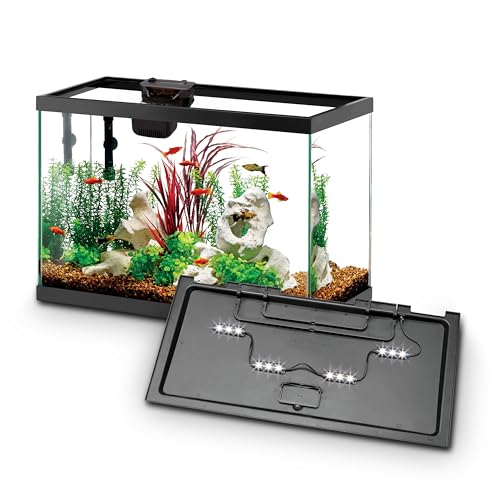
A 20-gallon glass kit with a SmartClean filter, LED hood and a heater preset to 78 degrees F. Gravel, fish and decor are separate.
According to Aqueon, the kit includes the glass aquarium, a low-profile hood with cool white LEDs and a front feeding door, a SmartClean internal power filter with an easy water-change function and adjustable flow, a biodegradable EcoRenew cartridge, a submersible preset heater, a thermometer, a net, and food and water conditioner samples. Fish, gravel and decor are sold separately. Aqueon’s page says the heater holds a constant 78 degrees F. Aqueon’s kit page lists a 50-watt heater for the line, so confirm the wattage on the listing for the 20-gallon size before you buy.
This is the easiest starting point because the equipment is already matched to the tank. Read our Aqueon 20 Gallon Starter Kit profile for the full contents.
Tetra 20 Gallon Complete Kit: A Familiar Setup With a Heater
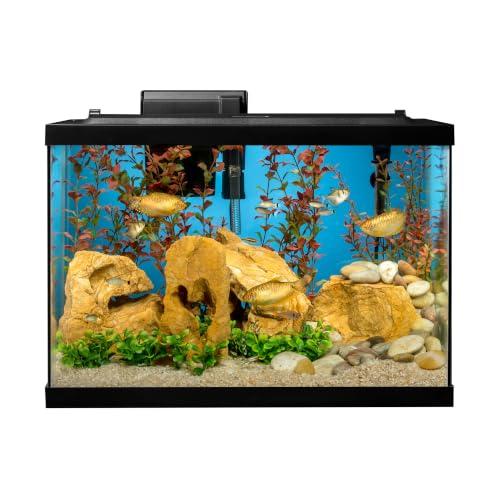
A 20-gallon glass tank with a Whisper PF 20 filter, white LED hood, a 100-watt heater and a thermometer in the box.
Tetra’s page lists a 20-gallon glass tank measuring 24 inches wide by 12 inches deep by 16 inches high, a low-profile hinged hood with white LEDs, a Whisper PF 20 power filter with a Large Bio-Bag cartridge, a 100-watt heater and a thermometer. It also includes a net, an AquaSafe water conditioner sample, a TetraMin food sample and a setup guide. It is the most compact footprint of the three at 24 inches wide, which helps in an apartment. The page does not say the kit is for tropical fish, so choose species by their own needs. See the Tetra 20 Gallon Complete Kit profile.
GloFish 20 Gallon Premium Kit: A Showpiece You Finish Yourself
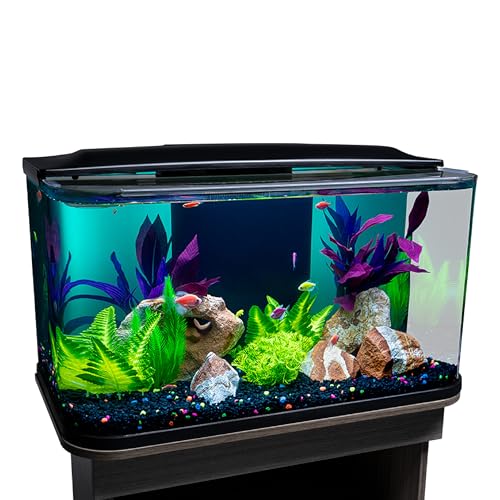
A curved-glass-front 20-gallon tank with a back-panel filter and three-way LED light. It has no heater, so plan to add one.
GloFish describes a 20-gallon tank with a seamless curved glass front, a hood with white and blue LED light sticks and a glass canopy, and a back-panel filter with 3-stage filtration. The light stick has 12 white, 12 blue and 12 magenta LEDs with a three-way switch. GloFish says a heater is not included and the back panel has space for one. A matching GloFish 20-gallon stand with rounded corners is sold separately. Choose this one if looks matter and you are willing to buy a heater; our GloFish 20 Gallon Premium Kit profile lists the details.
Weight, Stand and Location
Fresh water weighs about 8.345 pounds per gallon, according to Inch Calculator, so the water in a 20-gallon tank weighs about 167 pounds. Glass, gravel, decor and equipment add to that. Use a stand or furniture made to hold an aquarium, on a level floor, away from direct sunlight and drafts, and near an outlet. Aqueon’s kit text does not list a stand, and GloFish sells its matching stand separately.
Also leave room above the tank: hoods open for feeding and filter changes, and cords need a drip loop so water cannot run to the outlet. Aqueon’s page links a drip loop guide, which is worth reading.
Aquariums and Families
A tank can be a good shared project, with some ground rules.
- An adult handles electricity. Plugging in heaters, filters and lights, unplugging them for maintenance and anything that puts hands in the water near a power strip should be done by an adult.
- An adult does the water changes. Water changes involve buckets, siphons and equipment that must be unplugged first.
- Children can help with watching and feeding, with supervision and in small amounts, following the food maker’s directions.
- Never release fish. The U.S. Fish and Wildlife Service says released aquarium pets can outcompete native species and that releasing them is illegal. Pennsylvania Sea Grant says unwanted fish, plants and turtles must never be released. Use dontletitloose.com to find a new home if needed.
We do not frame these kits as products for young children. They are household equipment, and an adult owns the responsibility.
Quick Checklist Before You Order
- Measure the spot and confirm the stand holds a filled 20-gallon tank.
- Decide whether you want a heater in the box or will buy one.
- Buy a water test kit and a water conditioner.
- Choose gravel and decor that suit the fish you plan to keep.
- Plan six to eight weeks to cycle the tank before adding fish.
Sources
- UF/IFAS Extension: Ammonia in Aquatic Systems
- U.S. Fish and Wildlife Service: Don’t ditch your fish
- Pennsylvania Sea Grant: Tips for Aquarium Owners
- Inch Calculator: Aquarium Tank Weight Calculator
- PetMD: Betta Fish Care Sheet
- Aqueon Starter Kit with SmartClean Filtration and LED (official product page)
- Tetra Complete LED Aquarium Kit 20 Gal (official product page)
- GloFish Glass Aquarium Kit 20 Gallon (official product page)
Frequently asked questions
What is the best size aquarium for a beginner?
Bigger tanks are generally more forgiving because waste is diluted in more water, which is why we focus on 20-gallon kits. Pet-care publisher PetMD makes the same point about bettas: larger tanks keep temperature and water chemistry steadier. A 20-gallon tank also needs a sturdy, level stand, so plan the location first.
How long does a new aquarium take to cycle?
University of Florida IFAS Extension says a new biological filter needs six to eight weeks to build up enough bacteria to convert ammonia to nitrite and then to less toxic nitrate. It also says nitrite is toxic to fish at levels as low as 0.10 mg/L, so use a test kit and add fish slowly.
Do these kits come with a heater?
The Aqueon 20 Gallon Starter Kit includes a submersible preset heater that holds 78 degrees F, and the Tetra 20 Gallon Complete Kit lists a 100-watt heater. The GloFish 20 Gallon Premium Kit does not include one; its back panel has space for one.
How much does a filled 20-gallon aquarium weigh?
Fresh water weighs about 8.345 pounds per gallon, according to Inch Calculator, so the water alone in a 20-gallon tank is about 167 pounds. Glass, gravel, decor and equipment add more, so use a stand made to hold an aquarium on a level floor.
Is an aquarium a good family project?
It can be, with an adult in charge. An adult should handle plugging in equipment, water changes and anything involving electricity near water, and children can help with feeding under supervision and watching the fish. Follow each manufacturer's instructions.
What do I do with fish I can no longer keep?
Never release them outdoors. The U.S. Fish and Wildlife Service says released aquarium pets can outcompete native species and that releasing them is illegal. It points owners to dontletitloose.com for rehoming.