We earn a commission if you buy through our links, at no extra cost to you.
Best Aquarium for Betta Fish: 3 Kits That Fit
What a betta needs from a tank: 5 gallons or more, a heater, gentle flow and a cover. Three kits that fit, and what each one leaves for you to buy.
At a glance
A betta needs at least 5 gallons, a heater holding 76 to 81 degrees F, gentle flow and a cover. The Aqueon 10 Gallon Starter Kit includes a 78 degree preset heater. The Fluval Spec 5 and Marineland Portrait 5 suit desks but need a separate heater.
A betta is the fish most people picture when they imagine a small tank on a desk, and that is exactly why so many end up in cramped bowls. Veterinary and pet-care sources agree that a betta needs more than a bowl: a real aquarium, a stable warm temperature, a gentle filter and a cover. This guide explains those needs one by one, then shows which of three kits in our lineup fit them and what each leaves for you to buy. For the full ranking of every kit we cover, see our best aquarium kits of 2026 comparison.
Product details come from the manufacturers’ own pages or, for Fluval, from a retailer page that reproduces Fluval’s listing. Husbandry guidance comes from a university veterinary college, a pet-health publisher, university extension and federal sources, all listed at the end. We compared the published specs; we did not set these kits up.
What a Betta Needs From a Tank
Size: 5 gallons is the practical floor
The University of Illinois College of Veterinary Medicine says bettas should not live in bowls and recommends a “5-gallon glass or plastic tank or larger.” It explains that this size lets the fish swim and hide normally and keeps toxins from building up as quickly. PetMD sets a lower minimum of 2.5 gallons but calls 10 gallons or larger ideal, because bigger tanks keep temperature and water chemistry steadier. Our picks start at 5 gallons and include a 10-gallon option for exactly that reason.
Temperature: a heater is part of the setup
The Illinois column says a betta’s tank needs to stay within 76 to 81 degrees F and points out that most homes are cooler than that, so an in-tank heater is needed. PetMD gives the same 76 to 81 degree range, recommends a thermometer to confirm it, and suggests a heater even in homes that stay warm, to prevent swings. This is the biggest practical difference between the kits below: one includes a heater and two do not.
Gentle flow
The Illinois column says a low-flow filter is vital so a betta’s delicate fins are not injured by the suction of a filter. PetMD likewise advises low or adjustable flow. When you compare kits, look for an adjustable pump or flow setting, then run it on the low side and watch how the fish swims.
A cover
PetMD’s supply list includes a lid or cover and notes that bettas can jump. Check how each hood or canopy closes, and keep gaps small.
Patience before the fish arrives
A new tank has no beneficial bacteria yet. University of Florida IFAS Extension explains that fish waste produces ammonia, bacteria convert it to nitrite and then to the much less toxic nitrate, and a new biological filter needs six to eight weeks to build up enough bacteria. The same publication says nitrite is toxic to fish at levels as low as 0.10 mg/L and that ammonia can be present without any smell or color, so a water test kit is part of the shopping list. Plan to run the empty tank for weeks, not days, and ask a reputable fish retailer how to cycle it.
The Short List
| Kit | Size | Heater in the kit | Cover | Best for |
|---|---|---|---|---|
| Fluval Spec 5 | 5 gallons | Not listed | Frosted plastic cover | A tidy desk tank |
| Aqueon 10 Gallon Starter Kit | 10 gallons | Yes, preset to 78 F | Hood with front feeding door | The most complete setup |
| Marineland Portrait 5 | 5 gallons | Not listed | Sliding canopy | A compact tank with moonlight mode |
Fluval Spec 5: The Desk-Friendly Choice
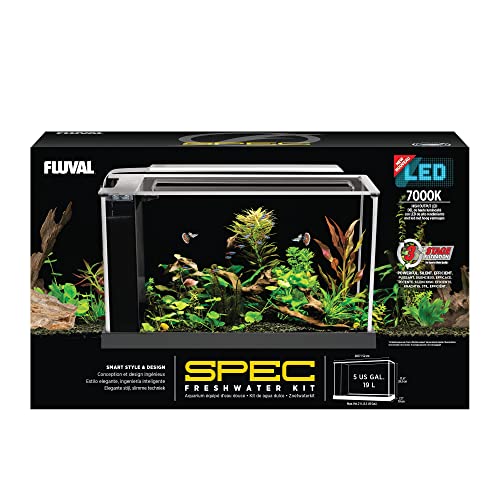
A 5-gallon desktop tank with three-stage filtration hidden behind frosted glass and an adjustable-flow pump. Plan to add a heater.
According to Fluval’s listing as carried by LiveAquaria, the Spec 5 holds 5 gallons and measures 20.5 inches by 7.5 inches by 11.6 inches high. That meets the Illinois 5-gallon recommendation, and the long, narrow shape leaves room for plants and hiding places along the back. The pump is rated at 53 gallons per hour with adjustable flow control and an output nozzle, which is what you want for a fish with delicate fins. The kit includes a frosted plastic cover, a clip-on LED light and a low-voltage power supply. The listing does not mention a heater.
The trade-off is volume. Five gallons is the smallest size we would suggest for a betta, and the temperature and water chemistry in a small tank can shift quickly. That makes a heater with a thermometer and regular water checks more important here, not less. Read the full details in our Fluval Spec 5 profile.
Aqueon 10 Gallon Starter Kit: The Complete Setup
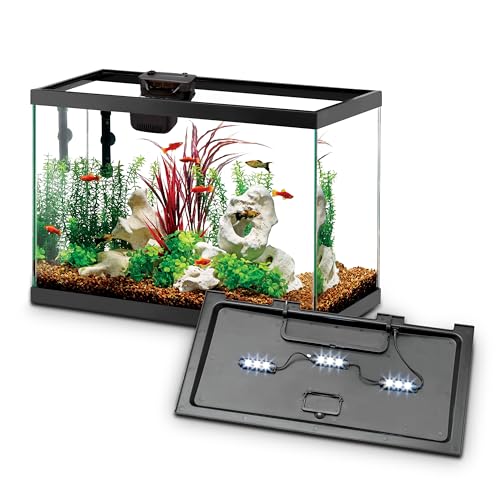
Ten gallons with a preset heater, LED hood and an adjustable-flow SmartClean filter. The only kit here that includes the heater.
Aqueon’s page for this kit lists a 10-gallon glass aquarium, a low-profile hood with cool white LEDs and a front feeding door, and a SmartClean internal power filter with an adjustable flow rate. It also lists a submersible preset heater, rated at 50 watts, that holds the water at a constant 78 degrees F, which sits inside the 76 to 81 degree range the Illinois column gives for bettas. The kit adds a stick-on thermometer, a water conditioner sample, a fish food sample and a net. Fish, gravel and decor are sold separately. Aqueon lists the dimensions as 14 x 23.75 x 16.5 without units; they read as inches.
For a first-time betta owner this is the simplest path: one box covers tank, heater, filter and light, and the 10-gallon volume is the size PetMD calls ideal. The cost is footprint. At roughly two feet long it will not fit on a small desk the way the 5-gallon kits will. See our Aqueon 10 Gallon Starter Kit profile for the full contents list.
Marineland Portrait 5: The Compact Alternative
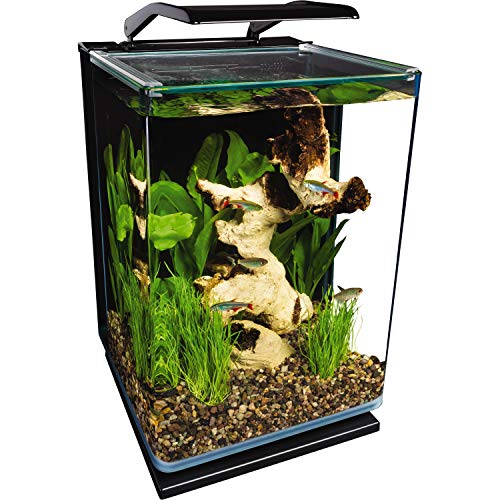
A 5-gallon glass kit with hidden three-stage filtration, an adjustable-flow pump and white and blue LEDs. Add your own heater.
Marineland’s page describes a five-gallon glass aquarium with three-stage hidden filtration, an adjustable-flow pump, white and blue LEDs with a three-way switch, and a sliding canopy for feeding and water-care dosing. The blue setting produces a moonlight glow that some owners like for evening viewing. Marineland’s page does not list a heater, dimensions, weight or warranty terms, so check the Amazon listing or the manual for the footprint before you pick a spot. Our Marineland Portrait 5 profile lays out what the page does and does not say.
How to Choose
- You want the least shopping: the Aqueon 10, because the heater and thermometer are already in the box.
- You have a small desk or shelf: the Fluval Spec 5, using its listed 20.5-inch length as your measuring point.
- You like a lighting mode for evenings: the Marineland Portrait 5, with its blue moonlight setting.
If you pick a 5-gallon kit, budget for a small heater and a thermometer. PetMD suggests a heater rated at roughly 3 to 5 watts per gallon. Choose a model sold for small tanks and check that it fits the tank’s depth.
Setting Up Safely
- Weigh the spot. Fresh water weighs about 8.345 pounds per gallon, according to Inch Calculator. That is about 42 pounds of water in a 5-gallon tank and about 83 pounds in a 10-gallon tank, before glass, gravel and equipment. Use a level, sturdy surface.
- Rinse and arrange. Rinse gravel and decor, and avoid sharp edges that could tear fins.
- Set the flow low. Start the pump on its lowest setting and raise it only if needed.
- Add the heater and thermometer. Confirm the water settles in the 76 to 81 degree range before fish go in.
- Cycle first. Wait for the six to eight weeks UF/IFAS describes, and test for ammonia and nitrite.
- Keep a cover on. Leave only small gaps for cords and feeding.
Rehoming and Responsible Ownership
Fish are living animals, so plan for their whole lives before you buy. If you can no longer keep a betta, never release it into a pond, creek or storm drain. The U.S. Fish and Wildlife Service says released aquarium pets can outcompete native species and that releasing them is illegal, and Pennsylvania Sea Grant gives the same warning for fish, plants and turtles. The Fish and Wildlife Service points owners to dontletitloose.com for rehoming.
Sources
- Bettas Need More Than Bowls (University of Illinois College of Veterinary Medicine)
- PetMD: Betta Fish Care Sheet
- UF/IFAS Extension: Ammonia in Aquatic Systems
- U.S. Fish and Wildlife Service: Don’t ditch your fish
- Pennsylvania Sea Grant: Tips for Aquarium Owners
- Inch Calculator: Aquarium Tank Weight Calculator
- Aqueon Starter Kit with SmartClean Filtration and LED (official product page)
- Marineland Portrait Desktop Kit (official product page)
- Fluval Spec V 5 Gallon Desktop Aquarium Kit (LiveAquaria product page)
Frequently asked questions
What size aquarium does a betta fish need?
The University of Illinois College of Veterinary Medicine recommends a 5-gallon glass or plastic tank or larger and says bettas should not live in bowls. PetMD says bettas do best in at least 2.5 gallons and calls 10 gallons or more ideal because bigger tanks keep temperature and water chemistry steadier.
Do bettas need a heater?
Both sources we read say yes in most homes. The University of Illinois gives a range of 76 to 81 degrees F and notes that most homes are cooler, so an in-tank heater is needed. PetMD gives the same range and suggests a heater even where the room stays warm, to prevent swings.
Which of these kits comes with a heater?
Only the Aqueon 10 Gallon Starter Kit. Aqueon lists a submersible preset heater that holds 78 degrees F. The Fluval Spec 5 listing and the Marineland Portrait 5 page do not mention a heater, so you would add one.
Can a betta live in a tank with a strong filter?
A strong current is a problem. The University of Illinois says a low-flow filter is vital so delicate fins are not injured by suction, and PetMD advises low or adjustable flow. All three kits here use an adjustable pump or flow rate, so turn it down.
How long should I wait before adding a betta to a new tank?
University of Florida IFAS Extension says a new biological filter needs six to eight weeks to build enough bacteria to convert ammonia to nitrite and then to less toxic nitrate. Test the water with a kit and follow the advice of a reputable fish retailer.
What should I do if I no longer want my betta?
Never release it outdoors or flush it. The U.S. Fish and Wildlife Service says released aquarium pets can outcompete native species and that releasing them is illegal. It points owners to dontletitloose.com for rehoming options.