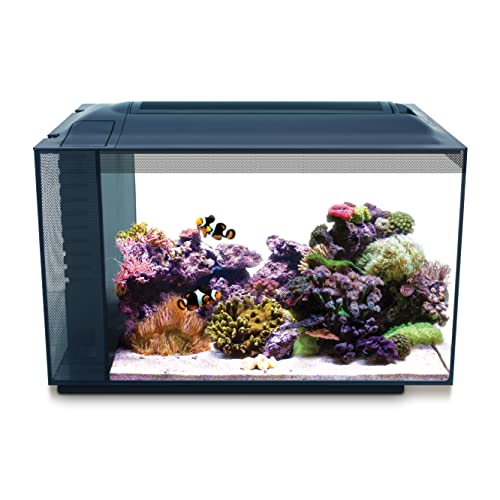
Saltwater tanks have a reputation for being complicated, and the Fluval Evo XII is Fluval’s attempt to shrink the problem to desktop size. It pairs a small glass tank with a reef-capable LED and a rear filter compartment that is designed to hold the extra equipment a marine tank needs. It sits near the bottom of our premium group in size, and, unlike the reef-oriented all-in-ones above it, it is sold specifically as a saltwater kit.
This profile summarizes what retailers publish about the kit, what it leaves out, and who is likely to be happy with it. Fluval’s own site blocks automated access, so the specs below come from the retailer listings we could open. We compared specifications; we did not set this tank up. For the other premium options, read our ranking of the best premium aquarium kits.
The Short Version
The listing describes a high-output 14,000K LED with an aluminum casing and touch-start day and night illumination, powerful three-stage filtration with oversized mechanical, chemical, and biological media, and a rear compartment hidden behind a honeycomb wrap. It is sold as a saltwater or marine reef kit.
The key caveat is what is not included. According to the That Pet Place listing, the heater and the protein skimmer are sold separately, although the rear compartment is designed to hold Fluval’s M50W heater and PS2 Mini protein skimmer. You also need marine salt, a way to measure salinity, test kits, and live rock or decor. Count the equipment before you count the tank.
Key Specs According to Retailer Listings
These details come from the That Pet Place and Josh’s Frogs listings for the Fluval Evo 13.5 gallon kit.
- Capacity: 13.5 gallons. The That Pet Place title says 12 gallons while its description says 13.5, so confirm the capacity on the Amazon page.
- Dimensions: 22 by 11.5 by 15 inches, per Josh’s Frogs.
- Lighting: 14,000K LED, reef-capable, with 31 LEDs and touch-start day and night illumination. Josh’s Frogs lists 16 watts and 1,383 lumens.
- Filtration: Three stages with oversized foam, carbon and biological media.
- Pump: 132 US gallons per hour, per Josh’s Frogs.
- Canopy: Multi-functional canopy with a feed door.
- Rear compartment: Hidden by a honeycomb wrap, designed to fit the Fluval M50W heater and PS2 Mini protein skimmer, both sold separately.
- Water type: Saltwater, marketed for mini reefs and coral growth.
- Not listed: Heater, protein skimmer, stand, and weight.
Retailers’ figures differ in places, so treat this list as a guide and check the Amazon listing for the exact contents.
Lighting for a Mini Reef
A color temperature of 14,000K is a bluer, reef-oriented spectrum, and the listing calls the light reef-capable. That is the main reason the Evo belongs in a saltwater conversation and not just on a desk. A white freshwater light would make corals look washed out and would not suit them, while a reef LED shows fluorescent colors better.
The touch-start day and night modes are a practical touch. You tap the light to switch between the main lighting and a dimmer night mode, which is pleasant in a room you use in the evening. As with any reef light, the right intensity depends on the animals you keep, so research the needs of any coral before you buy it, and add a simple outlet timer for a consistent schedule.
Filtration and the Rear Compartment
The three-stage system uses foam for mechanical filtration, carbon for chemical filtration and biological media, all described as oversized. The pump is listed at 132 gallons per hour, which turns over a 13.5-gallon tank nearly ten times an hour, a lot of flow for fish that prefer calm water and a reasonable amount for corals that like movement.
What stands out is the compartment design. The honeycomb wrap hides the rear chamber, and the listing says it is designed to take Fluval’s M50W heater and the PS2 Mini protein skimmer. A protein skimmer removes dissolved organic compounds before they break down, which is a common tool in saltwater tanks. Check the sizes carefully before you buy aftermarket equipment, since the compartment is compact.
What You Will Need to Buy
A saltwater tank has a longer list than a freshwater kit.
- Heater. The listing says the compartment is built for Fluval’s M50W. Add a thermometer you can read easily.
- Protein skimmer. The PS2 Mini is the model the compartment is designed for.
- Marine salt mix and a measuring tool. You need a hydrometer or refractometer to check salinity. Use a clean container for mixing water.
- Test kits. Ammonia, nitrite, nitrate, and salinity at minimum.
- Substrate, live rock or decor, and a stand. The listing does not include a stand.
If you are not ready for saltwater, a freshwater kit with similar styling is the Fluval Spec 16, and the Fluval Edge 2.0 is another compact freshwater option.
Small Saltwater Tanks Take Patience
A small volume of water changes quickly. A bit of extra food or a missed water change moves temperature, salinity and waste levels faster in 13.5 gallons than in a big tank. That is the main risk for a beginner and the reason many hobbyists suggest starting with hardy, small animals and a slow pace.
The University of Florida’s IFAS Extension explains that a new biofilter requires six to eight weeks to build up enough bacteria to reduce ammonia and nitrite, and that nitrite is toxic to fish at levels as low as 0.10 mg/L. That timeline applies in salt water too, so cycle the tank before you add animals, and add them one at a time. Ask a local fish store, ideally one that specializes in marine animals, what species suit a tank this size.
Weight and Placement
Inch Calculator gives salt water at about 8.554 pounds per gallon, so 13.5 gallons is roughly 115 pounds of water alone, plus glass, rock, substrate, and equipment. The listing does not give the weight of the tank, so we do not guess at it. Use a stand or sturdy piece of furniture that is rated for the weight and level, near an outlet, away from direct sun and heating vents. Salt creep is a fact of life with marine tanks, so keep a towel handy, place the tank where occasional drips will not damage a floor, and use a drip loop for cords.
If you ever need to give up your animals, do not release them. Pennsylvania Sea Grant warns that released aquarium species can establish and become invasive.
Pros and Cons
Pros
- Reef-capable 14,000K LED with touch-start day and night modes
- Three-stage filtration with oversized media
- 132-gallon-per-hour pump
- Rear compartment designed for a heater and protein skimmer
- Compact footprint for a desk or counter
Cons
- Heater and protein skimmer are sold separately
- Stand not included
- Small volume means water quality changes quickly
- Retailer listings disagree on capacity and light output, so check carefully
- Saltwater needs more equipment and attention than freshwater
Who Should Buy It
The Evo suits someone who wants to start a small saltwater or mini reef tank, accepts that the heater, skimmer, and test kits are extra, and is ready for a careful first few months. It is a good fit for a hobbyist who wants a reef-capable light in a compact package.
It is not the right pick for anyone who wants an all-inclusive, low-effort tank. A larger saltwater tank is often more forgiving, and a freshwater kit asks less of the owner. Our Coralife BioCube 16 is another compact all-in-one option, and the Fluval Spec 5 is a smaller freshwater desktop tank.
What to Check Before You Buy
- Capacity: Confirm 13.5 gallons on the Amazon page.
- Heater and skimmer: Add both to your plan.
- Salt and test gear: Buy a salinity tool and test kits.
- Stand: Plan for about 115 pounds of water plus equipment.
- Cycling: Allow six to eight weeks for the biofilter, per IFAS.
You can check current pricing and options here: Fluval Evo XII 13.5 on Amazon. Buying through our link may earn a commission at no cost to you.
Sources